Best Catering Management Software in India (2026): 9 Tools Compared Honestly
Mahipal, Founder, CaterCaptain · Oct 21, 2026 · 14 min read
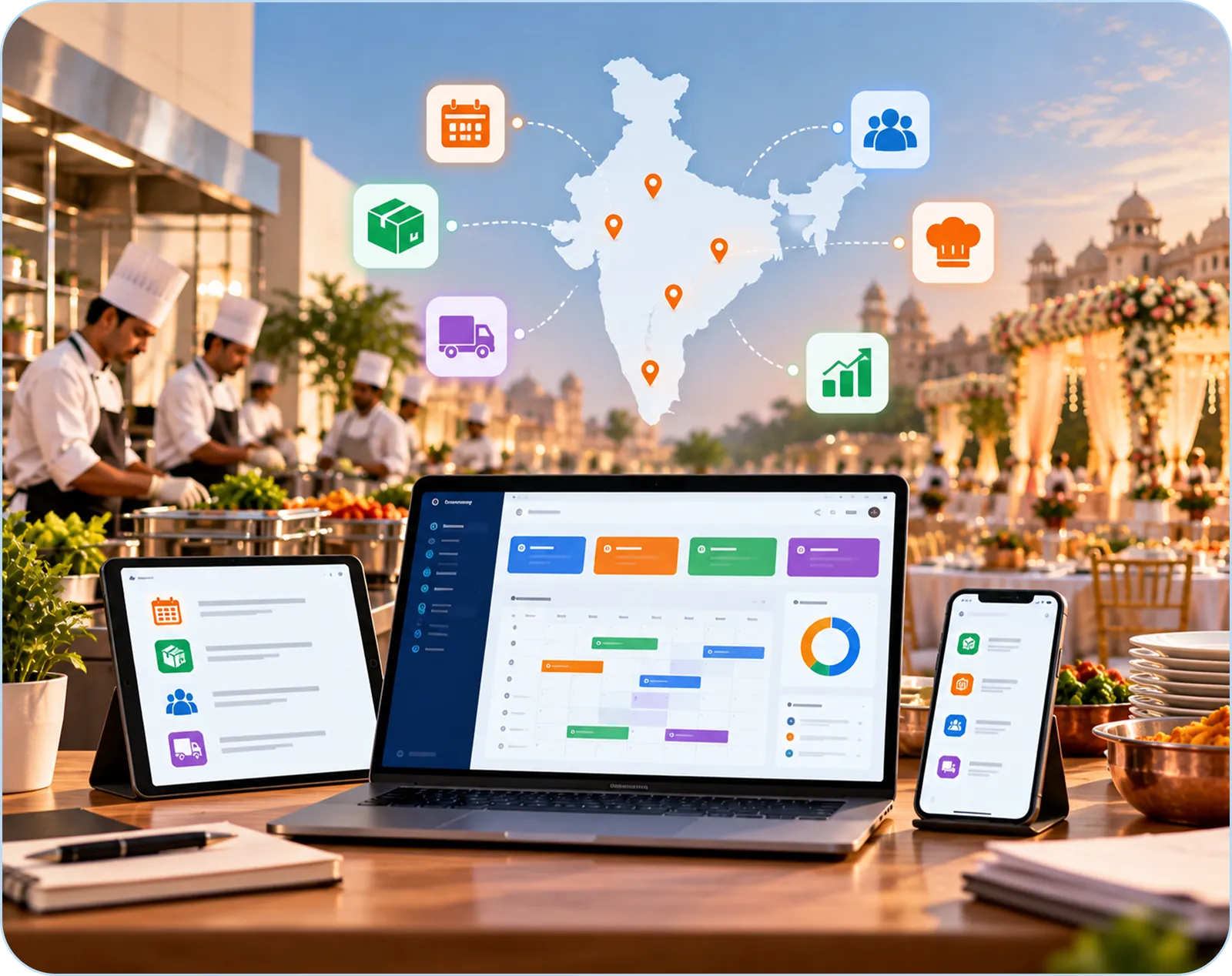
The Idea Behind CaterCaptain
Most software for caterers is built far from any actual kitchen - global products that assume drop-off catering and card payments, or generic restaurant POS stretched over an industry it doesn't understand. We took the opposite bet: build deep for one place first. Here's the reasoning, openly.
There is no single best catering software in India. There is a best one for the size and shape of your business, and most of the 'best catering software' lists you will find are written by one vendor ranking itself first, or by directories that have never cooked for 500 people. This guide compares nine tools that Indian caterers actually consider, with prices taken from each vendor's own website on 15 October 2026, and says plainly where a competitor is the better choice. CaterCaptain is our product, and we have tried to be as hard on it as on the others.
The short version: a solo caterer doing a handful of small events a month will be well served by DineOpen or Petpooja and should not pay for more. A caterer running one kitchen with 10 to 30 events a month, who mainly needs quotations, menu reports and raw material lists, should look hard at Jucas; it has been in Gujarat for years and has 200+ customers. A caterer with an HQ warehouse feeding two or more kitchens, who loses money between dispatch and the venue, is the business CaterCaptain was built for. Institutional contract caterers running hostel or canteen sites should read the MealPe and CaterCaptain sections and ignore the rest.
The nine tools at a glance
Prices are the vendor's own published figures as of 15 October 2026; where a vendor does not publish pricing we say so rather than guess. Indian plans are quoted as the vendor states them (some exclude 18% GST, noted in the detail sections).
| Tool | Built for | Public starting price | Where it is strongest | India fit |
|---|---|---|---|---|
| CaterCaptain | Caterers with an HQ store feeding 2-5 kitchens; institutional contract caterers | ₹999 first month; Standard ₹19,999/yr, Premium ₹39,999/yr, GST included | Norms-based quantities, HQ-to-kitchen dispatch and receive, batch costing, per-event P&L, Gujarati/Hindi/English | Strong: built in Ahmedabad for Gujarat workflows; young product (launched 2026) |
| DineOpen | Restaurants that also cater; solo caterers | ₹899/month, 7-day trial, no transaction fees | Event calendar, per-plate costing, payment tracking, restaurant POS in the same product | Good for small operators; no HQ dispatch or multi-kitchen model |
| BuildMenu | Caterers who sell on proposals and need a CRM | From ₹999/month (plan detail requires login) | AI menu builder, branded PDF proposals, WhatsApp quote links, GST invoices, lead pipeline | Good for sales-led caterers; light on kitchen and dispatch operations |
| Jucas | Single-kitchen event caterers in Gujarat and Maharashtra | ₹24,000 first year, ₹8,000/yr after (3 users); add-ons for accounts, WhatsApp, mobile app | Menu reports, raw material lists, counter name plates, agency and labour distribution | Strong: 200+ Indian caterers, Gujarati market, Android/iOS app |
| MealPe | Institutional and corporate canteens | Not published | Employee ordering, cafeteria management, corporate meal programmes | Good for the consumer side of a canteen; not an HQ supply-chain tool |
| Petpooja | Restaurants; caterers only as an add-on | Not published; user reports put base POS at ₹12,000-18,000/yr plus modules | Billing, KOT, aggregator integrations, large support network | Strong POS, weak catering: no event lifecycle, no per-plate norms, no dispatch |
| Posist | Restaurant chains and hotels | Quote-based | Multi-outlet restaurant operations, banquet module for hotels | Enterprise restaurant tool; catering is a side module |
| Caterease | US and Canadian event caterers and venues | $85-165/month per user (₹7,300-14,200), plus ~$200 per-user launch fee | Proposals, BEOs, event management; 50,000+ users worldwide | Poor: no GST, USD billing, no Indian language, no per-plate norms |
| CaterZen | US drop-off and delivery caterers | $179-229/month (₹15,400-19,700) | Online ordering, CRM, marketing automation, delivery management | Poor: US workflows, no GST, no Indian event model |
Rupee conversions at ₹86/$ for comparison only. Note what the table does not show: Caterease and CaterZen appear on every Indian directory list because those directories copy global listings, not because Indian caterers use them.
Why a restaurant POS is not catering software
Petpooja and Posist are excellent restaurant systems and poor catering systems, and the reason is structural, not a missing feature. A restaurant sells a fixed menu to walk-in customers at one location, bills per item, and restocks daily. A caterer sells a custom menu for a date weeks away, to 300 to 3,000 people, at a venue it does not own, bills per plate with an advance and a balance, and buys raw material once per event from an HQ store.
The practical consequences when a caterer runs on a POS:
- There is no event. The system has orders and bills, so a three-day wedding becomes a dozen unrelated bills and nobody can see the whole function.
- There is no quantity engine. A POS deducts ingredients when a dish is sold; it cannot tell you to buy 42 kg of paneer for 500 guests next Saturday.
- There is no dispatch. Stock lives at one location. The moment material leaves the store for a venue, the POS has no record of what went, what arrived and what came back.
- There is no per-event margin. The POS knows revenue per bill; it does not know that the Shah reception cost ₹4.1 lakh in material and labour against ₹4.5 lakh billed.
If you already run a Petpooja outlet and cater five events a month on the side, keep the POS and add nothing. If catering is the business, the POS is the wrong starting point however good the brand is.
Seven things that decide whether catering software pays for itself
Every vendor's feature list is long. These seven are the ones that move money, with a way to test each one in a demo instead of taking the salesperson's word.
| What to check | Why it matters | How to test it in the demo |
|---|---|---|
| 1. Per-plate norms, not recipes | Indian caterers plan in grams per plate (paneer 40 g, oil 15 ml), not in restaurant recipes that serve four. Software that only scales a recipe will be ignored by your head cook | Ask them to enter your own norm for one dish and generate the list for 650 guests. If it takes more than two minutes, it is not built for this |
| 2. Event, not order | One function can be three days, five services and two kitchens. The event must be the unit that holds menu, staff, dispatch, billing and profit together | Ask to see a multi-day event with different guest counts per service on one screen |
| 3. HQ-to-kitchen dispatch with receive and return | This is where stock disappears. If the software cannot show what left the store, what the captain received, and what came back, it cannot show you your real material cost | Ask: "My storekeeper sent 14 kg paneer, the venue got 12. Show me where that appears." Most tools cannot |
| 4. GST quotation in one screen | Guest count × per-plate rate, extras, discount, round-off, GST shown or hidden, PDF and WhatsApp send. If the quotation is built in Word, the software is not saving the owner's time | Build one quotation live. Time it |
| 5. Per-event P&L after the event | The only number the owner really wants. It needs actual material (from dispatch and returns), labour, transport and extras against the invoice | Ask to see a completed event's profit screen, not a dashboard mock-up |
| 6. The storekeeper's phone, in his language | The owner buys; the storekeeper and the captain use it daily. If it is not in Gujarati or Hindi and does not work on a ₹10,000 Android phone at 375 px, adoption fails silently | Open the demo on the salesperson's phone, not the laptop, and switch the language |
| 7. Transparent pricing | Per-user fees, "first year" prices that drop later, add-ons for WhatsApp and mobile, and prices quoted before GST all change the real cost | Ask for the three-year total for your exact team size, in writing, including GST |
If a product passes 1, 3 and 5 it will pay for itself in a season. If it passes only 4 and 6 it is a good quotation tool, which is fine if that is all you need.
The nine tools, one by one
1. CaterCaptain - for HQ-plus-kitchens operators and institutional contracts (our product)
CaterCaptain is built in Ahmedabad around one idea: the booking should produce the whole operational plan. You enter per-plate norms once per dish; a confirmed event of 650 guests then produces the raw material requirement, the labour plan, the shortage list against HQ stock, and the planned margin. Kitchens raise material requests, HQ approves and dispatches in batches with vehicle and driver, the captain taps "Receive All" on his phone, returns and wastage are recorded after the event, and the event closes with an actual P&L built from what really moved. Every quotation, invoice, dispatch list and payment reminder goes out on WhatsApp in one click, and the whole product runs in Gujarati, Hindi and English on a phone browser.
Pricing is ₹999 for the first month, then Standard at ₹19,999 a year (1 HQ + 2 kitchens, 5 users) or Premium at ₹39,999 a year (1 HQ + 5 kitchens, multi-kitchen dispatch), with 18% GST included and a 30-day money-back guarantee. No per-user fees inside the plan, no transaction fees.
Where it is weaker, honestly: it launched in 2026, so it has a fraction of Jucas's customer base and references. It does not print counter name plates or manage outside agencies the way Jucas does. There is no native app yet (an Android captain app is in pilot with one institutional caterer), WhatsApp sending is one-click but not yet automated from your own number, and the learning features that suggest quantities from your own history are not live and are not sold until they are. If your operation is one kitchen and your pain is reports, Jucas will feel more complete today.
Choose CaterCaptain if you have an HQ store and two or more kitchens, you have lost money between dispatch and the venue, you want to know each event's real margin within three days of the event, or you run hostel, canteen or mess contracts across sites.
2. DineOpen - the cheapest credible option for small caterers
DineOpen is a restaurant POS from Bangalore that has built a catering mode: event calendar with conflict detection, per-plate costing from recipes, staff allocation, advance and instalment tracking, GST invoicing and procurement lists, at ₹899 a month with a 7-day trial and no transaction fees. Its comparison post ranks itself first for every segment, which you should discount, but the underlying product is real and the price is hard to argue with.
Its limits are the POS inheritance. Costing is recipe-based (serves 4 × 200) rather than per-plate norms, there is one inventory location rather than an HQ dispatching to kitchens, and there is no receive/return loop, so the "actual cost" after the event is only as good as what someone types in. Language support is listed as Hindi and regional, not Gujarati specifically.
Choose DineOpen if you are a solo or family caterer doing 5 to 15 events a month, or a restaurant that caters on the side, and you want calendar, costing and payments for under ₹11,000 a year.
3. BuildMenu - proposals, CRM and WhatsApp quotes
BuildMenu is a newer Indian cloud product aimed at the sales side of catering: a lead pipeline, an AI menu builder, branded PDF proposals, interactive quote links sent over WhatsApp, and GST invoices with deposit milestones. It markets "from ₹999/month"; the plan table itself sits behind a login, so get the exact tier limits in writing.
It also lists recipe costing, inventory depletion, kitchen prep sheets and staff attendance, but these are secondary to the proposal flow. There is no HQ dispatch model and no multi-kitchen stock movement.
Choose BuildMenu if your business wins or loses on the quotation, you handle many enquiries, and you want a CRM that caterers will actually use.
4. Jucas - the established choice for single-kitchen event caterers
Jucas, from QDev Technolab in Gujarat, is the product most Gujarat caterers have already heard of, and for good reason: it lists 200+ catering customers, 15 lakh orders processed, and a customer wall that reads like a who's who of Surat, Ahmedabad, Rajkot and Vadodara caterers. The core plan is ₹24,000 for the first year and ₹8,000 a year from the second, for 3 users, with extra users at ₹1,500 a year.
What it does well: order and menu management from enquiry to confirmation, menu reports in multiple designs, counter name plates printed straight from the menu, a raw material list that splits groceries, vegetables and dairy, crockery distribution, labour and outside-agency distribution, fixed packages, quotation/invoice/proforma, QR table menus, and a "ground file" that bundles everything the event manager needs. The Android and iOS app is a ₹3,999/yr add-on; WhatsApp, email and SMS sending is a ₹5,000/yr add-on; finance, payroll and stock is ₹12,000 first year then ₹4,000.
Where it is a different fit: Jucas is organised around the order and the report, which is exactly what a single-kitchen caterer needs. It is not built around the store and the kitchen: dispatch with receive and return, batch costing, and an actual P&L from what was really consumed are outside its scope, so the raw material report tells you what to buy rather than what the event finally cost. Fully loaded (core + accounts + WES + app) the first year is ₹44,999 and later years ₹20,999, before GST.
Choose Jucas if you run one kitchen, do 10 to 40 events a month, want excellent printed reports and counter plates, and your biggest pain is the paperwork before the event rather than the stock after it.
5. MealPe - the consumer side of institutional catering
MealPe positions itself as India's software for institutional and corporate caterers: employee meal ordering, cafeteria management, corporate meal programmes, feedback and billing per employee. It is the right tool when the problem is "how do 2,000 employees order and pay for lunch".
It is not the right tool when the problem is "what did my HQ send to the hostel kitchen in Mehsana, what did they consume, and what is my cost per meal there". That operator-side supply chain is what CaterCaptain's recurring-operation mode covers. The two are complementary rather than competing. Pricing is not published.
6. Petpooja - keep it for the restaurant
Petpooja, also from Ahmedabad, is probably the most installed restaurant POS in India, with excellent billing, KOT and aggregator integrations and a large local support network. Pricing is not published; user reports put the base POS at roughly ₹12,000–18,000 a year with inventory, CRM and online-ordering modules as add-ons. For catering it has no event lifecycle, no per-plate norms and no dispatch, as covered above.
Choose Petpooja if you run restaurants or sweet shops and catering is under 20% of revenue.
7. Posist - for hotel banquets and chains
Posist is an enterprise restaurant platform used by chains and hotels; pricing is quote-based. Its banquet module suits a hotel selling its own hall, where the kitchen, the venue and the billing are all in one building. For an independent caterer dispatching to other people's venues it is the wrong shape and the wrong price.
8. Caterease - the global name that does not fit India
Caterease has 50,000+ users and twenty years of event-planning depth: proposals, BEOs, room diagrams, contracts. Plans run $85 to $165 per user per month, roughly ₹7,300–14,200, with a one-time per-user launch fee of about $200. It bills in USD, has no GST invoicing, no Indian languages and no per-plate norms. It appears on Indian directory lists because the directories copy global catalogues. Skip it unless you cater for embassies and bill in dollars.
9. CaterZen - US drop-off catering, not Indian events
CaterZen is built for American drop-off and delivery caterers: online ordering sites, CRM, marketing automation, delivery management, at $179 to $229 a month (₹15,400–19,700). Good product, wrong country. No GST, no event-day model, no HQ dispatch.
Also seen on directory lists
IndiaMART carries a dozen one-off "catering management software" builds at ₹2,000 to ₹45,000 as a one-time price. These are typically desktop or custom builds with no updates, no mobile and no support beyond the seller. The low price is real; so is the dead end when the developer moves on. Indian Mesh and similar tiffin systems are for daily tiffin delivery, not events.
Feature comparison
Based on each vendor's published feature pages and, for Jucas and CaterCaptain, demos. "Partial" means the capability exists but in a limited form (for example recipe scaling rather than per-plate norms, or single-location stock rather than HQ dispatch). Verify anything marked Partial in your own demo.
| Capability | Jucas | CaterCaptain | DineOpen | BuildMenu | MealPe | Petpooja | Posist | Caterease | CaterZen |
|---|---|---|---|---|---|---|---|---|---|
| Event lifecycle (enquiry → event → close) | Yes | Yes | Yes | Yes | No | No | Partial | Yes | Yes |
| Multi-day, multi-service events | Yes | Yes | Partial | Yes | No | No | Partial | Yes | Partial |
| Per-plate norms engine | Partial (raw material report) | Yes | Partial (recipe scaling) | Partial (recipe costing) | No | No | No | No | No |
| HQ-to-kitchen dispatch with receive/return | No | Yes | No | No | No | No | No | No | No |
| Multi-kitchen stock | No | Yes | No | No | No | Multi-outlet | Multi-outlet | No | No |
| GST quotation and invoice | Yes | Yes | Yes | Yes | Yes | Yes | Yes | No | No |
| Per-event actual P&L | No | Yes | Partial | No | No | No | No | Partial | Partial |
| Labour / staff per event | Yes | Yes | Yes | Partial | No | No | No | Yes | Partial |
| Outside agency / vendor management | Yes | No | No | No | No | No | No | Yes | Yes |
| Counter name plates | Yes | No | No | No | No | No | No | No | No |
| Crockery and equipment tracking | Yes (distribution) | Yes (with returns) | No | No | No | No | No | Partial | No |
| Institutional / recurring meal operations | No | Yes | Partial | Partial | Yes (ordering side) | No | No | No | No |
| WhatsApp sending | Add-on ₹5,000/yr | Included (one-click) | Yes | Yes | Yes | Yes | Yes | No | No |
| Gujarati UI | Reports multilingual | Yes | No | No | No | No | No | No | No |
| Native mobile app | Add-on ₹3,999/yr | In pilot (captain app) | Web | Web | Yes | Yes | Yes | Web | Yes |
| Free trial | Demo | ₹999 first month, 30-day refund | 7 days | Trial | Demo | Demo | Demo | No | Yes |
| Prices published | Yes | Yes | Yes | Starting only | No | No | No | Via directories | Yes |
Which one for your size of business
| Your business | What hurts most | Shortlist | Skip |
|---|---|---|---|
| Solo or family caterer, 5–15 events a month, 50–300 guests | Remembering bookings, chasing payments, quoting fast | DineOpen, BuildMenu | Everything above ₹20,000 a year; you will not use it |
| One kitchen, 15–40 events a month, 10–30 staff | Menu reports, raw material lists, counter plates, labour lists before the event | Jucas first; CaterCaptain Standard if you also want per-event profit | Petpooja, Posist, global tools |
| HQ store plus 2–5 kitchens, 500–3,000 plate events, 30–100 staff | Stock leaving HQ and not coming back; not knowing the margin until the CA closes the books | CaterCaptain Premium; Jucas plus Accounts if reports matter more than dispatch | POS products |
| Institutional contracts: hostels, canteens, mess, 2–20 sites | Cost per meal per site; what each site consumed vs plan; attendance across sites | CaterCaptain (recurring operations); MealPe for the employee-ordering side | Event-only tools |
| Restaurant or sweet shop that also caters | Billing and KOT first, occasional events | Petpooja or DineOpen; add nothing | Dedicated catering software |
| Hotel with its own banquet hall | Venue bookings, hall diagrams, banquet billing | Posist; Caterease if you bill in USD | Independent-caterer tools |
Two rules that hold whichever row you are in. First, test with a real upcoming event, your own norms and your own guest count, on a phone, with the person who will use it daily in the room. Second, get the three-year cost in writing including GST and every add-on; first-year prices and per-user fees change the picture more than the headline number.
Frequently asked questions
What is the best catering management software in India?
It depends on the shape of the business. For a single-kitchen event caterer who needs menu reports and raw material lists, Jucas is the most proven option with 200+ customers. For a caterer running an HQ store and several kitchens, or institutional contracts, CaterCaptain is built for that supply chain. For a solo caterer or a restaurant that caters on the side, DineOpen at ₹899 a month covers the basics.
How much does catering software cost in India?
Published Indian prices in October 2026 range from ₹899 a month (DineOpen) and ₹999 a month (BuildMenu) to ₹8,000–24,000 a year for Jucas's core plan and ₹19,999–39,999 a year for CaterCaptain, GST included. Add-ons for WhatsApp, mobile apps, accounts or extra users can add ₹5,000–20,000 a year. US tools such as Caterease and CaterZen cost ₹7,000–20,000 a month and bill in dollars.
Is Jucas or CaterCaptain better?
Jucas is stronger on pre-event paperwork: menu reports, counter name plates, agency and labour distribution, and it has far more customers. CaterCaptain is stronger on what happens to stock after it leaves HQ: dispatch, receive, returns, batch costing and per-event profit, and runs fully in Gujarati. Many caterers would be well served by either; the deciding question is whether your losses happen before the event (quoting, planning) or after it (stock, margin).
Can I use Petpooja for my catering business?
Only if catering is a side business to a restaurant. Petpooja has no event lifecycle, no per-plate quantity engine and no dispatch to venues, so pure caterers end up managing the event on WhatsApp anyway and using the POS for billing alone.
Does catering software work in Gujarati?
CaterCaptain's full interface runs in Gujarati, Hindi and English. Jucas prints reports and counter plates in multiple languages. DineOpen lists Hindi and regional languages. The global tools are English only.
Is there free catering software in India?
No serious catering product is free. DineOpen offers a 7-day trial, CaterCaptain offers the first month at ₹999 with a 30-day money-back guarantee, and Jucas offers a demo. Free spreadsheets and WhatsApp remain the real competitor, and they cost 8–15% in material over-ordering according to the caterers we work with.
What should I check before paying for catering software?
Seven things: per-plate norms rather than recipes, the event as the unit of work, HQ-to-kitchen dispatch with receive and return, a one-screen GST quotation, per-event actual P&L, a phone interface in your staff's language, and the three-year total price including GST and add-ons.
Sources
All prices and feature claims were taken from these pages on 15 October 2026.
- Jucas pricing and Jucas home page
- CaterCaptain pricing and features
- DineOpen catering comparison and pricing
- BuildMenu comparison page and pricing
- MealPe institutional catering page
- Petpooja pricing as reported by users (DineOpen review)
- Caterease pricing on TrustRadius and Caterease plan changes, PricingSaaS
- CaterZen pricing on Capterra
- Directory listings: Techjockey, SoftwareSuggest, Capterra India, IndiaMART
About the author: Mahipal is the founder of CaterCaptain, catering operations software built in Ahmedabad for Gujarat's caterers. Book a 30-minute demo on WhatsApp or start for ₹999 for the first month.