Digital vs Paper Records in Catering: An Honest Comparison
Mahipal, Founder, CaterCaptain · Jul 24, 2026 · 3 min read
The Idea Behind CaterCaptain
Most software for caterers is built far from any actual kitchen - global products that assume drop-off catering and card payments, or generic restaurant POS stretched over an industry it doesn't understand. We took the opposite bet: build deep for one place first. Here's the reasoning, openly.
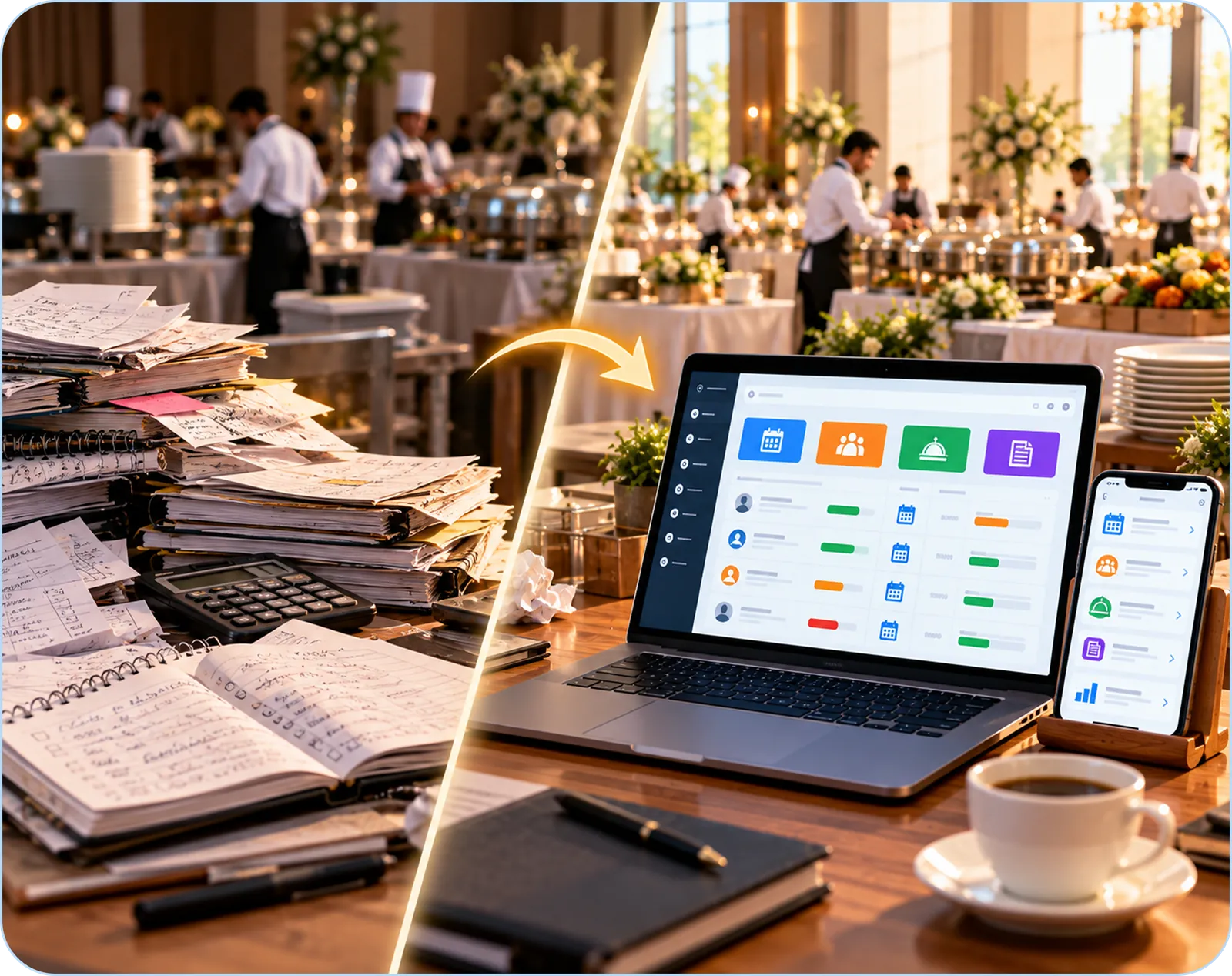
Paper built the Indian catering industry - and defending it entirely, or mocking it entirely, both miss the point. The honest question isn't "paper or digital?" but "which records, at which scale, fail on paper first?" Here's the fair comparison.
Where paper genuinely works
- Single kitchen, single decision-maker: when the owner sees everything personally, a good register plus a great memory is a complete system.
- The kitchen floor moment: a wall chart of today's production plan beats any screen for at-a-glance, flour-covered-hands usability.
- Low event volume: at 3–4 events a month, the coordination load rarely exceeds what one disciplined notebook handles.
Where paper silently fails
- Anything that must be in two places: the dispatch register is in the vehicle when HQ needs it. Paper exists in one location; catering operations don't.
- Anything that must be searched: "what did we quote the Mehta family last year?" is thirty seconds digitally and an evening with a carton of files on paper.
- Anything that must be summed: per-event P&L, monthly consumption, vendor-wise spend - paper holds the entries but never does the arithmetic, so the arithmetic never happens.
- Anything contested: registers written by one party persuade nobody in an HQ-vs-kitchen or staff-payment dispute. Timestamped shared records end arguments; notebooks extend them.
- Anything that outlives a person: twenty years of norms in the head cook's diary - and in his head - walks out the day he does.
When should a catering business switch from paper to software?
Digitise when any two of these become true: (1) more than one kitchen or dispatch location, (2) more than ~8 events a month, (3) more than one person who needs the same information, (4) you've had two or more record-based disputes in a season, (5) you cannot answer "which events made money last quarter?" within an hour. Under two, paper plus discipline is defensible. Over two, paper is costing more than it saves - you're just not receiving the bill as one line item.
The hybrid truth
Well-run digital caterers still use paper - as a display layer (kitchen wall charts printed from the system) and a capture buffer (a pocket note during a power cut, entered that evening). The system of record is digital; paper serves the moment. What fails is the reverse: paper as the record, digital as an afterthought - the worst of both.
The real cost comparison: paper's price is invisible - hours searching, disputes unresolved, arithmetic never done, knowledge unshared. Software's price is a visible number per month. Businesses consistently overweight the visible cost and underweight the invisible one; the correction is simply counting both.