How to Reduce Food Waste in Your Catering Business (and Add 3–5% Back to Margin)
Mahipal, Founder, CaterCaptain · Jun 10, 2026 · 3 min read
The Idea Behind CaterCaptain
Most software for caterers is built far from any actual kitchen - global products that assume drop-off catering and card payments, or generic restaurant POS stretched over an industry it doesn't understand. We took the opposite bet: build deep for one place first. Here's the reasoning, openly.
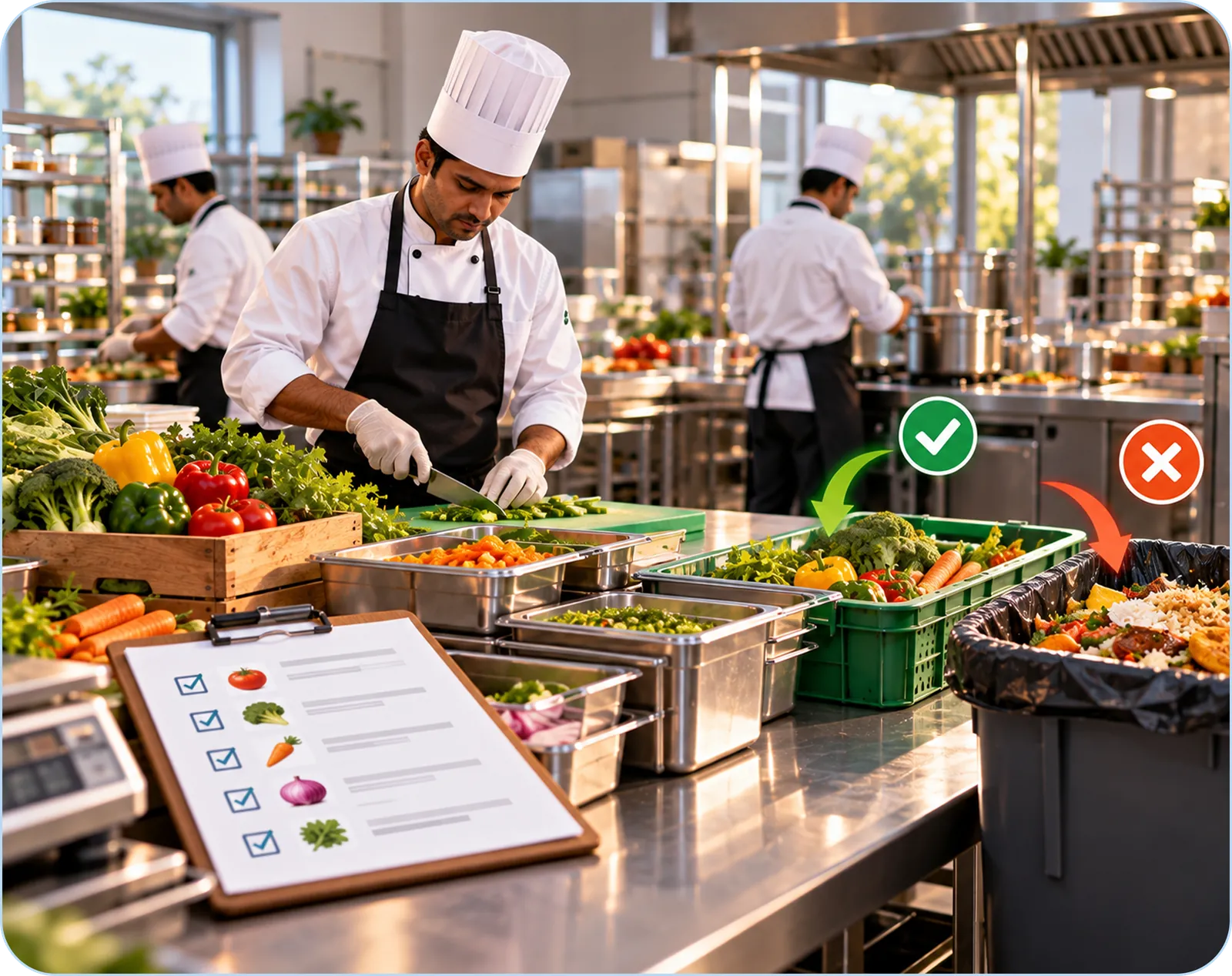
Waste in catering hides in plain sight. Nobody throws away money on purpose - it leaves as an extra tray of pulao "just in case," a sweet that always over-runs, and cooked food nobody counted. Across a season, 8–12% of material spend commonly walks out as waste. Recovering even a third of that is pure margin.
Where does food waste in catering come from?
- Guest-count padding stacked on padding. The client says 500 "but maybe 550." You cook for 580 to be safe. The head cook adds his own buffer. Now you've cooked for 620 and 470 showed up.
- No per-dish norms. When quantities come from instinct, they drift upward - nobody ever got shouted at for cooking too much, so the instinct is always "thodu vadhare."
- Sweets and fried items over-produced - the most expensive categories are also the most padded, because running out of jalebi feels catastrophic.
- Nothing measured after the event. If leftover quantity is never recorded, the same over-ordering repeats forever.
The fix, in four habits
One buffer, owned by one person
Set the buffer policy explicitly - say 6% above confirmed count - and make it the owner's number, not something every layer adds silently. Stacked buffers are the single biggest waste source.
Cost-ranked production
Cook paneer, dry-fruit sweets and fried items closest to confirmed count; keep flexible-capacity items (rice, dal, rotli) as your live-adjustment lever. Guests forgive waiting 5 minutes for fresh rotli; your margin doesn't forgive 8 kg of leftover kaju masala.
Log leftovers per event - even roughly
"Approx 6 kg pulao, 3 kg gulab jamun returned" takes 2 minutes to record. After 5 events, patterns are undeniable and your ordering tightens itself. This is exactly the kind of entry a waste log in your operations system makes routine instead of optional.
Have a surplus plan before the event
Coordinate with local food-recovery organisations or staff-meal plans in advance. Surplus handled with dignity is good ethics and good reputation; surplus scraped into bins at midnight is neither.
Real math: a caterer doing ₹40L/year in material purchases who cuts waste from 10% to 6% recovers ₹1.6 lakh a year - without one new booking.
Track it or it didn't happen
Waste reduction fails as a resolution and works as a routine. The routine needs three numbers per event: planned quantity, consumed quantity, waste quantity. Whether that lives in a register or in software, the caterer who has those three numbers per event will out-earn the one who doesn't - on identical bookings.